
Okay, real talk — 3D printing is awesome. I own multiple printers. I've been geeking out over this technology since my grad school days in the late 90s. There is genuinely nothing like watching a design materialize layer by layer at 2am while you sip coffee and feel like a wizard.
But here's the thing. After 25+ years of designing, engineering, and manufacturing physical products across industries — medical devices, aerospace, consumer goods, automotive — I've watched some incredibly talented engineers fall into a sneaky trap. And recently? I caught myself falling into it too. So consider this less of a warning and more of a "hey, I've been there" from someone who learned the hard way.
Let's talk about what happens when the 3D printer becomes your hammer and every problem starts looking like a nail.
Trap #1
The Tech Is Amazing — But It Has Limits
Materials aren't magic.
Those filaments and resins are engineered for printability first, performance second. A printed part and an injection-molded part made from nominally the same plastic? Completely different animals in terms of strength, consistency, and durability. And depending on whether you're using FDM, SLS, or something else, your part's strength will behave differently in X, Y, and Z directions. The YouTube influencer hyping up that new exotic filament isn't doing your stress analysis for you.
Scale is a real conversation.
3D printing shines for prototyping and tiny runs — it's genuinely brilliant for that. But traditional manufacturing wins on speed and cost even at surprisingly modest volumes. The dangerous scenario is when a design gets locked in around what prints nicely, then has to be completely rethought for mass production. Surprise redesigns are nobody's idea of a good time.
Consistency can be sneaky.
Print-to-print variation in density, strength, and finish is real. That means two "identical" parts might behave differently in testing — and if you don't know that's happening, you might be solving the wrong problem entirely.
Trap #2
The Sneakier Problem: What Gets Crowded Out
This is the one that really keeps me up at night, and it's got nothing to do with the technology itself.
When 3D printing becomes the default answer, some genuinely important skills start getting quietly dropped from the process. I've met senior design engineers who had never produced a detailed 2D drawing, run a GD&T callout, or touched an FEA or CFD analysis. Skills that used to be year-one fundamentals. When I ask about those steps, I get one of two answers: "The manufacturer will handle it" or the spine-chilling "It worked in the prototypes."
Here's what tends to get squeezed out when print-first thinking takes over:
- Exploring alternatives gets skipped. When you can iterate a design in hours, it's tempting to just keep tweaking the same concept rather than stepping back and asking whether a completely different approach — or a different manufacturing method altogether — might be better. Some of the best design breakthroughs come from constraints, and 3D printing removes a lot of constraints that are actually useful to think through.
- Analysis goes shallow. Fast iteration is a superpower, but it can also become an excuse to move forward without fully thinking through long-term implications. Rushing into management buy-in before the design is really vetted? That's happening more often now, and it rarely ends well.
- Engineers optimize for the print, not the product. This one is subtle and insidious. It's easy to spend days getting a 3D-printed feature to work beautifully without ever asking whether that feature even makes sense in the final manufactured part. The print becomes the goal instead of the means.
- Other testing methods get forgotten. Simulations, mathematical modeling, hand-fabricated prototypes in production-representative materials — these all offer insights that a printed part simply can't. A quick back-of-napkin stress calculation takes 15 minutes and might save you a 30-hour print job and a week of head-scratching.
So What's the Play?
Simple: keep 3D printing in its rightful place as one excellent tool in a well-stocked toolkit — not the whole workshop.
The best product teams use printing strategically, layered in with solid engineering analysis, DFM thinking, simulation tools, and good old-fashioned math. The exciting news is that AI-powered engineering analysis tools have never been more accessible or faster to use. There's really no excuse not to run a quick simulation or crunch some numbers before committing to an overnight print.
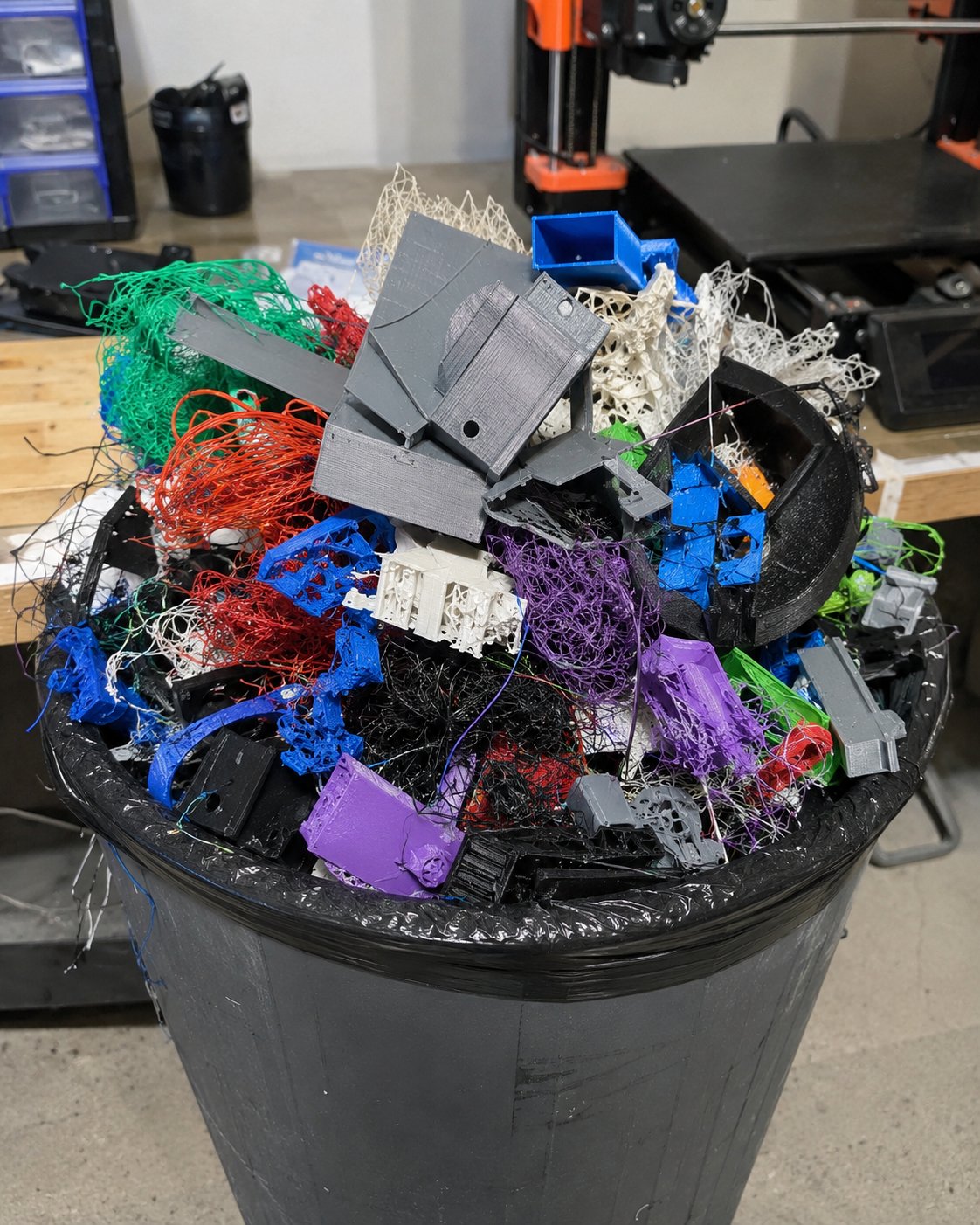
The goal isn't less 3D printing — it's smarter 3D printing. Match the right tool to the right moment, keep your full engineering skillset sharp, and your products (and your trash cans) will be better for it.
Now go make something great. Just maybe do the math first. 🖨